
« ROYAL COURT »
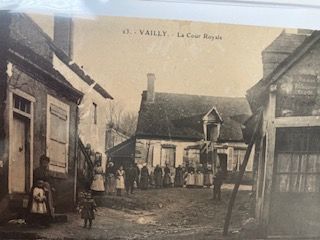
The name of « Royal Court » in Vailly-sur-Sauldre is one of the most prestigious remains of the judicial and administrative history of the village. It was not a residence for a king, but a place of power and justice.
Why is that name « Royal Court » ? Under the Old Regime, justice was done at different levels. Lord Justice: The Lord of Vailly had his own right of justice in his lands. The transition to « Royal » : At certain times, especially when the seigneury changed hands or the influence of the King of France was affirmed in the Berry (province attached early to the Crown), certain disputes or administrative acts were the responsibility of the Royal Provost or Bailiwick.
The Royal Court building was therefore the seat where the judge (the provost or bailiff) sat to settle trials, estates and crimes.
The building and its architecture.
Located in the ancient heart of the village, the Royal Court is often distinguished by its more imposing appearance than the surrounding peasant houses:
Solid construction: There are often country stone walls (the sandstone of Vailly) and worked openings that show the importance of the building.
The symbol of power: At the time, having a royal seat of justice in his village was a sign of great economic importance. This attracted prosecutors, notaries and lawmakers, making Vailly a small urban centre in the middle of the Pays-Fort. Life at the Royal Court (18th century) with:
Notarial acts: This is where the contracts of sale were signed, the leases of the mills (like the mill to which we referred) and the wills.
Prison: Often, these justice buildings had a dungeon on the ground floor or in the basement to hold the defendants before their trial.
After the Revolution in 1789, the system of seigneurial and royal justice was abolished.
The Royal Court loses its function as an official court in favour of the new republican structures (the justice of the peace).
The building then often became a private property or served as a common house (may) before modern town halls were built.
The little historical detail
The passage through the Royal Court was mandatory to validate the weights and measurements of the Vailly market. It was verified that no one cheated on the quantity of grain or wool sold, thus ensuring the « peace of trade » in the seigneury.
It's fascinating to see how every street in Vailly (the No need street, the Royal Court) tells a different facet of the society of the time: the people, justice and economy.