« THE MOULIN »
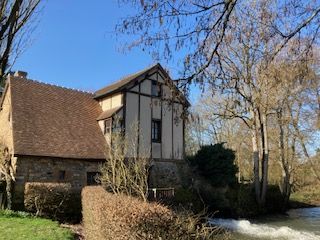
VALLY MOULIN ON SAULDER
which historically belonged to the Lordship of Vailly.
Its passage from a classic grain mill to a mill (or « Sheet mill ») in the 15th or 16th century tells all the textile epics of Berry.
The Lordship of Vailly and its « Right of Banality ». Under the Old Regime, the mill is not a mere business, it is a seigneurial privilege.
• The owner: The mill belonged to the Lord of Vailly (often linked to the families of Culan or Sully depending on the times).
• The obligation: The inhabitants of the seigneury were obliged to use this mill to process their products, in exchange for a tax (the « commonplace »).
• Location: He used the driving force of the Grande Sauldre, thanks to a bief (a bypass channel) and a waterfall designed to rotate a large wooden blade wheel.
What is a « Moulin à Foulon » ? (XV-XVIth century)
This is where history becomes technical and social. The Berry was then a land of sheep and wool.
• The mechanism: Unlike the flour mill that uses grinding wheels, the mill uses cam trees. These cams raise huge wooden mallets (the « Flour »).
• The process: The wool sheets were placed in tanks filled with water and water. « Foiled ground » (a special clay). The mallets struck the fabric to degrease, tighten and make it waterproof.
• Importance: In the 15th century, it was a state-of-the-art technology! Without this mill, the fabric remained loose and fragile. Vailly thus participated in the fame of the « Berry sheets ».
Evolution through the centuries
• The decline of textiles: From the 17th and 18th centuries onwards, competition from the royal manufactures and the change of fashion made the artisanal casting perish.
• Conversion: Like many mills, Vailly has often been converted into a wheat mill or bark mill (for tanning leather) to adapt to the local economy.
• The Revolution: In 1789, the mill ceased to be « commonplace » (Lordial) to become private property.
The building we see today (often simply called « The Mill ») keeps traces of these ancient times in its foundations or walls of sandstone.
• Heritage: Although the bolt mechanisms disappeared in favour of more modern milling systems in the 19th century, architecture remains typical of Sauldre's edges.
• The landscape: The mill's site, with its waterfall and its bay, is one of the most picturesque places in Vailly, showing 500 years of water work.