
The Common Well
THE COMMON POWER
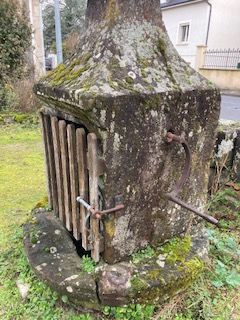
The common well of the sixteenth century is, with the church and pyramid barns, one of the most beautiful specimens of the heritage of proximity to the village.
The material: The famous « Varilly sandstone »
If this well is still standing and so well preserved, it is thanks to its raw material.
• The stone: It is carved in the local ferrous sandstone. It is an extremely hard stone, of red or brown colour, that resists centuries and weather.
• Extraction: At that time, this sandstone was extracted in the surrounding quarries of the Pays-Fort. The view used for a common well shows that the village community had the means to offer a sustainable structure.
A vital social role (16th century)
In the 16th century, running water did not exist. The well is the daily rallying point.
• Water for all: Unlike private wells hidden in the courtyards of rich houses or the Royal Court, the « Common well » belongs to everyone.
• The village forum: This is where we exchanged the latest news (the « Goats ») while waiting its turn to climb the bucket. There was discussion of wool crops or Sauldre floods.
Architecture and Mechanism
This 16th century well is typical of the Berrichonne rural Renaissance:
• The margin: It is massive, often worn out by the friction of ropes or chains for hundreds of years. It can sometimes be seen notches dug by the wear of time.
• The structure: He usually had a forged iron frame or a wooden gallows to hang the pulley.
• Security: In the 16th century, watertightness was started around the well to prevent runoff (often dirty at the time) from polluting the groundwater.
Why is he still here?
He survived the Revolution and modernization of the 19th century because, until the arrival of water under pressure in the houses (many later!), he remained an indispensable source of relief. Today, it is protected as an element of the small rural heritage (although it is on a private space).
If you look closely at the sandstone, you can sometimes see specific stone carving traces. The stone tailors of the 16th century sometimes left their « mark » (a geometric signature) on the largest blocks. This is the testimony of a know-how that passed from father to son in the Cher.