Church of St Germain – Barlieu
SAINT LEGISLATIVE BARLIEU – GERMAIN
From Barlieu's former stronghold in the Middle Ages, there is only the memory of ramparts in the name of a street. Nevertheless, this small town has nevertheless preserved beautiful traces of ancient habitat with interesting half-timbered houses like those that can be
admire rue Etienne Dolet.
The name Barlieu is attributed a double origin: Gaulish by the word « bar, bar » (high, high) and Latin with word « locus » (the place). Let's not forget that, following the previous Gallic routes, the Roman routes knew an intense traffic for trade and that a branch of the Via Aggripa leading up to Boulogne sur mer passed through Gien.
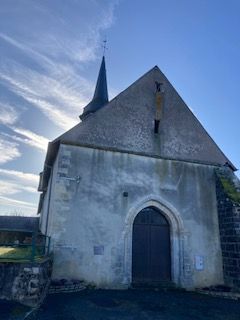
The church Saint-Germain attracts the look from afar, both by the height and by the very particular shape of its bell tower. The current building was built on a building dating back to the 11th or 12th century by raising and expanding it. The final volume dates back to the 16th. This story explains that there is a variety of styles, including openings.
For the visitor, the centres of interest begin with the bell tower, particularly elegant with a bulb-shaped soundshaft allowing a wide dispersion of bell bell rings. A small advance on the roof base will then be seen on the northern flank. It protects both reas
which allowed for the removal of double weights whose mass (about 45kg) led to the mechanism of ringtones. Only accessible from outside with a ladder, it was entrusted to a parishioner who, for this difficult task, received a comfortable salary of 20 pounds in 1690. We'll see, left.
of the gate, the commemorative plaque honoring a native priest of Barlieu, Abbé Brasdu, who had, at the risk of his life, sheltered a Jewish family during the occupation.
Inside: from the large gate (West) to the altar (East)
The first treasure of the church, already mentioned, is the mechanics of this first clock. An impressive assembly of nearly one cubic metre that must be realized that it was built with the file as the only tooling. Next door, we can practice lifting one of the weights, the one that was
recently extracted from the Cedar wall where it allowed to attach his horse, a day of market.
On the right, a large painting depicting a religious (St-Bernard?) in adoration of the Sainte-Vierge which gratifies him with a « lactation ». The work comes from the workshop of a painter from Bourges under the brush of a named Pinardeau. Each new priest made a commitment to transmit this painting to his own successor.
Around the nave, a cross path that has this particular to have been offered to Barlieu by Emperor Napoleon III. The signing is legible on the first table on the left.
On the central driveway we will discover a slab of black schist whose function was never clearly established and then the tombstones of local lords. This custom ends up being abandoned for hygienic and... olfactory reasons.
The Revolution had demanded that all peasants lay their manure in the nave in order to cause on the walls the production of saltpetre, indispensable for gunpowder.
In the choir, two busts are admired: on the left Saint-Germain, patron saint of the church and on the right Saint-Christine, protector of the parish. We will also see, on the right, on the ruin of the dedicated altar, a pretty statue of the Virgin with the child full of softness and elegance.
Arriving at the sanctuary, one can judge the effects of the « Modernism » on the altar of which only the front panel remains, itself hung behind, under the altarpiece. A very beautiful lamb in glory with four angelots at angles that deserved better than this set aside.
Boxed by two stained glass windows in arched bays in the middle of the hanger in St-Germain and SteChristine, the huge altarpiece (8.40 X 8.30) dates from 1732 and was manufactured and assembled by an artisan from Henrichemont. Of pure Baroque style, it is characterized by detail of ornamentation and columns of ionic style. It offers this singularity to show the face of God, which one sees
crowned with a flight of angelots. Below, the Christ, sent from the Father, holding in his left hand « Cruciferous orb » symbol of power and chalice with radiant hostie in the right.
The artist gave Christ the face of the model that laid, far from the emaciated faces of most representations.